Revision History
Updated publication: Nov 21, 2026
Author: Samantha Leonie
Original Publication: Nov 20, 2026
Author: Samantha Leonie
Healthcare Marketing Blogs – MediVerticals


A healthcare referral management system is the mix of people, rules, and software that moves a patient from “you should see a specialist” to a completed visit and a report back to the doctor who sent them. Every practice has one, even if it’s just a fax machine, a spreadsheet, and one coordinator who remembers everything. That setup holds until the coordinator takes a vacation or the volume doubles. Then referrals start slipping, and nobody notices because a missing appointment does not make noise.
Used well, a referral management system is more than an administrative tool. It becomes part of your growth strategy, alongside patient acquisition and broader practice optimization work.
This guide covers healthcare referral management from the first order to the closed loop: the workflow, the strategies that grow inbound volume, the KPIs worth tracking, how to compare referral management software for healthcare, and the federal rules that limit how you can reward referrals.
Every statistic names its source. Where no reliable national number exists, we say so instead of borrowing a vendor’s claim. Some sections speak mainly to specialty practices growing inbound referrals, and others to primary care practices sending patients out; we label which is which.

Healthcare referral management is the process of tracking a patient referral from the first order to a completed visit, and then to the consult note that goes back to the referring provider.
Referral management in healthcare starts with one distinction: closed-loop referrals and open-loop referrals. A closed-loop referral is tracked from the order, through the scheduled visit, to the consult note landing back with the referring provider. An open-loop referral is sent and then trusted to work itself out, usually a faxed page and a patient told to “call and schedule.” Open-loop is still common, and it’s where referrals go missing.
Two terms that are worth keeping apart here are non-completion and leakage. Non-completion means a referral that never becomes a completed visit. Leakage means a referral that becomes a completed visit somewhere else, such as a competitor or another health system. They call for different fixes, so this guide tracks them separately.
Three referral types matter here:
One more distinction: a clinical referral is not the same as an insurance-required referral. Some HMO plans require a referral from a primary care physician (PCP) before they will cover a specialist visit. This guide is about the clinical process, though your referral management solution should also capture what each payer requires.
The strongest US data we found comes from Duke. In a study published in the Journal of General Internal Medicine in 2018, researchers analyzed 103,737 primary care scheduling attempts to 20 high-volume specialties in fiscal year 2016 (July 2015 through June 2016). Only 34.8 percent ended in a documented completed appointment, and 38.9 percent had no documented appointment date at all.
Read that carefully, because documented is not the same as completed. Every one of the 19,288 out-of-network attempts lacked an appointment date, which made up about 48 percent of all undated attempts. The authors tied that to incompatible EHRs between health systems. The study also covers one academic system on Epic, so some visits may have happened off the record. Self-reported data paint a brighter picture: an Annals of Family Medicine study found that physicians reported 79.2 percent of referred patients had a specialist visit, and patients reported 83.0 percent. The truth for your practice likely sits somewhere between those figures, and you can’t know where without tracking it.
What about dollars? The peer-reviewed work measures completion, not revenue, and we couldn’t find an AMA or MGMA national figure for revenue lost to dropped referrals. Vendor pages quote six-figure losses per physician, but those numbers don’t trace to a primary study, so we’re not repeating them. Calculate your own:
Referrals per month × share that never complete × value of a completed first visit = monthly revenue at risk
The ROI example in the KPI section below runs that math. Under fee-for-service, dropped referrals cost downstream volume. Under value-based contracts, they surface in quality and total-cost measures instead. Most teams find their first leak at scheduling rather than at the order, and the Duke data point the same way.
A patient referral management system follows seven steps, whether it runs on paper or in software. Each step below lists a suggested owner and the place it usually breaks. Titles vary by practice; what matters is that one named person owns each step.

Scheduling is where the Duke data show the largest gap. Six percent of referred patients couldn’t be reached, 12 percent declined scheduling, and 18 percent of referrals needed more than one scheduling attempt. Across all scheduling attempts, 17.9 percent were canceled and 4.0 percent were no-shows. Automated reminders and a clear rule for who calls after a miss help close that gap.
MGMA’s guidance on closed-loop referral management makes the same point: every step needs a named owner.
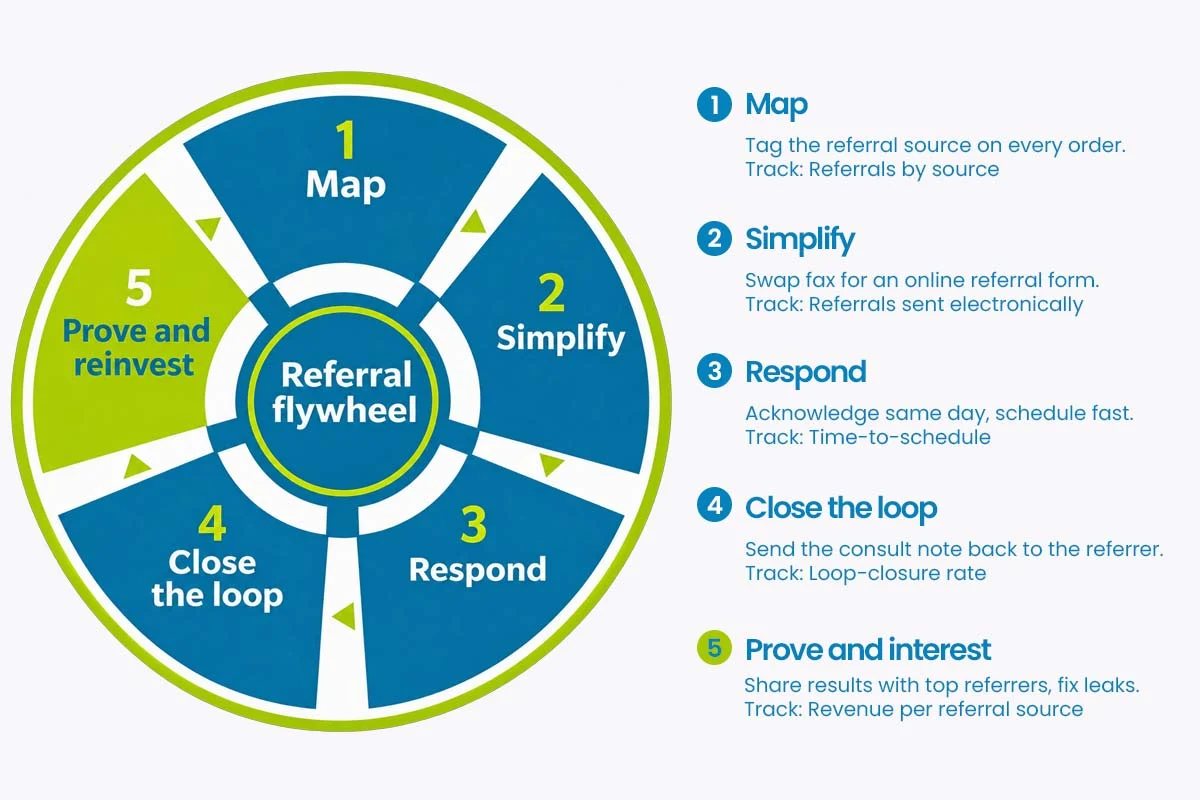
A healthcare referral management system works best as a loop, not a list. Each stage feeds the next, and the last one restarts the first.
Metric: volume and completion rate by referral source.
Metric: share of referrals that arrive complete on the first submission.
Metric: time to schedule
Metric: loop-closure rate.
Metric: completion rate by source.
At low volume, a spreadsheet can carry this. As you move into the hundreds of referrals a month, a referral management platform or other patient referral management software will track more reliably than a person can. The right switch point depends on your staff and specialties.
Physician referral management is a relationship job first and a systems job second. Doctors send patients where the process is easy, communication is reliable, and the patient comes back well-informed. A patient referral management system should make the referring office’s life easier, not add a second fax to its day.
Start with provider liaison outreach: a named person who visits referring offices, learns what each one needs, and fixes small problems before they become reasons to refer elsewhere. One physician we worked with did this in person. Over eight months, he booked 30 half-day clinic visits and ended up with more than 200 referrals a month. It demanded nothing clever, just consistent showing up. Results may vary by market and specialty.

Compliance note: meals, gifts, and free services for referring offices can raise Anti-Kickback and state-law issues. Keep outreach educational and unrelated to referral volume, and review the compliance section below.
Then build a “make it easy to refer” kit:
Add specialty-specific talking points. An orthopedic group might lead with same-week injury visits and on-site imaging. A pain practice might emphasize conservative-first pathways and quick reports back. A cardiology group can talk about test turnaround. Other strategies include:
Recognition counts, but keep it compliant: thank-you notes, outcome updates on shared patients within HIPAA’s treatment rules, and modest educational sessions open to all relevant clinicians whether or not they refer. Never tie anything of value to referral volume (details in the compliance section below).
Want a referral pipeline built for you?
MediVerticals’ referral-growth marketing combines liaison outreach, referrer content, and tracking for medical practices.

A physician’s personal brand is what colleagues expect when they hear your name: what you treat, how quickly you respond, and whether you send a clear note back. Those expectations form before anyone opens your referral form, and referrers and patients alike often look you up first. A recognizable local name can also earn referrals that would otherwise follow network defaults.
Four things build a brand that referrers trust:
Follow-through matters more than any of these. Acknowledging referrals promptly and returning consult notes is the brand in practice. A polished profile attached to a slow process undermines itself.
Installing a system is only the first step for referral management in healthcare. You also need to know whether it works. These KPIs show where referrals stall, where patients are lost, and how well your healthcare referral management is working. Pull them monthly and by referral source.

Example: if a practice receives 200 referrals and 140 result in completed appointments, the completion rate is (140 ÷ 200) × 100 = 70 percent.
Review these monthly and by source. A rising leakage rate from one office usually points to a specific problem you can fix. If you also track revenue by source, keep it internal. Never use it to reward or penalize referrers.
These figures are assumptions for illustration. Substitute your own. A specialty practice receives 400 referrals a month and completes 55 percent, or 220 visits. After tightening intake and follow-up, completion rises to 65 percent, or 260 visits. That’s 40 extra visits. At an assumed average first-year value of $900 per patient, that adds $36,000 a month. If the software and coordinator time cost $3,500 a month, net gain is $32,500, or roughly 9.3 times the monthly spend. Your own baseline may be lower than 55 percent; the Duke study counted only documented completions and found 34.8 percent, so measure yours before you promise a number.

When you evaluate referral management software for healthcare, look for four capabilities. Physician’s software solutions range from EHR modules to standalone medical referral software, and the best of either type covers all four.
Check the extras that save staff time: fax-to-structured-data conversion, patient texting for scheduling, insurance and authorization checks, and a signed business associate agreement. A good referral management solution should also export clean data for the KPIs above. A patient referral management system that can’t report is just a faster inbox.
EHR-native or standalone? Many practices should look first at the referral module inside their own EHR, since it avoids an interface. A standalone patient referral management software product earns its place when you need to work with referring offices on other EHRs, or when the built-in module lacks tracking and source-level reporting.
What does it cost? Vendors rarely publish prices, and models vary: per provider per month, per referral or volume tier, implementation and interface fees, or an add-on to your EHR subscription. We haven’t listed prices because we couldn’t verify any from primary sources. Ask for a written quote that covers interface fees, training, support, and what happens to your data if you leave.
This is an editorial shortlist for U.S. medical practices, specialty clinics, medical groups, and health systems, not a performance ranking. It covers the referral management software healthcare organizations commonly consider, grouped by what each tool does best. We looked at referral tracking depth, intake and routing, EHR integration, patient communication, and reporting. The patient referral software and medical referral software below differ in focus, from dedicated referral management to patient access and care coordination.
NuReferrals, powered by par8o. NuReferrals sits in the healthcare referral management space and puts the emphasis on coordinating referrals across provider networks. Evaluate its network capabilities, routing, communication workflows, and reporting, and confirm the current feature set with the vendor.
ReferralMD. ReferralMD is a referral management platform that covers intake, automated routing, scheduling, messaging between offices, and tracking. Specialty practices and networks that handle a lot of referrals usually see the biggest payoff. Check how it connects to your EHR and how much detail its reports give you.
ReferWell. ReferWell supports referral coordination and specialist scheduling, and it gives visibility into specialist availability. Provider networks can use it to reduce manual scheduling work. Look at its provider matching, EHR integration, and reporting.
Tennr. Tennr automates the paperwork-heavy side of referrals. Its AI-powered tools can read incoming records, pull out key details, and flag what’s missing. Practices with large referral volumes may find it useful. Confirm it also covers the tracking and reporting you need.
Treatspace. Treatspace is built around the conversation between referring providers and specialists, with provider networking, referral tracking, and information exchange. If strong relationships with referring offices are a priority, it’s worth a look. Ask about integrations and reporting.
Kyruus Health. Kyruus is mainly about provider data and helping patients find the right clinician by specialty, location, and insurance. Larger systems working on provider discovery are its natural fit. Provider search isn’t the same as end-to-end referral tracking.
Luma Health. Luma is built around patient access and engagement, using automated outreach, reminders, and scheduling. It can help your team reach referred patients without so much manual follow-up. Ask how its referral workflows connect with your EHR and scheduling systems.
Phreesia. Phreesia started with patient intake and registration and handles a good share of front-office paperwork. For referrals, it helps sort incoming information and documents, which is handy when orders arrive through several channels. Find out whether its tracking can follow appointments and outcomes the way your team needs.
athenahealth. athenahealth combines EHR, practice management, and patient engagement in one platform. It works best for practices that already use its connected tools. Review the referral functionality in your own configuration, including tracking, scheduling, and reporting.
Updox. Updox gives practices electronic faxing, secure messaging, and document sharing, so sending referral paperwork and consult notes gets easier. Independent practices tend to like it. Check whether it can assign referrals, track appointments, and report on closed loops, because those are not a given.
Details come from vendor listings and 2026 comparison roundups. Verify current features and pricing directly with each vendor before you buy.
Before picking a referral management system, write down your baseline: monthly referral volume, completion rate, and how referrals arrive today. You can’t prove ROI without it.
A realistic 12-week timeline:
Vendor timelines vary, so ask for theirs in writing.
Staff training should be role-based. The coordinator learns the queue and escalation rules. Front desk staff learn how to enter referrals completely. Providers learn how to read status and what to do when a loop stays open. Book a 30-day follow-up, since habits slip fast. The referral management software healthcare practices choose succeeds or fails on adoption, not features.
Quick callouts by practice type:
The right referral management platform for a five-provider clinic is rarely the right one for a 40-location system, so choose for the practice you are, not the one you hope to be. A good system should also be easy to explain to a new hire in an hour.


The goal is simple: track and grow referrals without paying for them. Here’s how the federal laws fit together.
What’s generally safer:
Consult a healthcare attorney. This is general information, not legal advice. Any program that touches referrals, gifts, or marketing should be reviewed by counsel who knows your state.
A multi-specialty referral management system should support centralized intake, specialty-specific routing, insurance and authorization workflows, automated alerts, secure provider communication, and reporting across locations. It should integrate with your EHR and scheduling systems and offer the security and audit capabilities that support HIPAA compliance.
Healthcare referral management gives both offices a shared view of each referral. Primary care physicians can see when the patient was scheduled, seen, or missed, and consult notes return to the sender without a phone call. The result is fewer lost patients and stronger trust between the two practices.
Traditional tracking is usually a spreadsheet or log of what was sent. A patient referral management system goes further: it automates tasks, verifies insurance, reminds patients, alerts staff to stalled referrals, closes the loop with the sender, and reports on volume, wait times, and leakage.
Yes. Patient referral management software takes over much of intake, insurance checking, and patient outreach, which is where many delays start. Alerts flag any referral that hasn’t been scheduled within your set window, and multi-site groups can route patients to the earliest opening.
Many platforms consolidate fax, phone, and electronic referrals into one workflow. Depending on the product, faxed documents can be converted into structured data, and phone referrals can be entered through standard forms. EHR and portal integrations reduce manual entry further, so staff work from one list instead of several inboxes.
An open-loop referral is sent and then trusted to work itself out. A closed-loop referral is tracked from the order through the scheduled visit to the consult note returning to the referring provider.
Pricing varies by vendor and model, including per provider per month, per referral or volume tier, implementation and interface fees, or an EHR add-on. Ask each vendor for a written quote that covers interface fees, training, support, and data export if you leave.
Generally no. Paying anyone per referral for business covered by federal health care programs creates serious Anti-Kickback risk, and many states have similar rules. Pay flat, fair-market fees and have a healthcare attorney review the arrangement.
At low volume, yes, if every referral has an owner, a status, and a follow-up date, and someone checks for stalled referrals weekly. Move to software when volume or the number of referring offices outgrows what one person can track.
Referral management in healthcare isn’t glamorous, but it’s where a lot of growth is quietly won or lost. Pick one owner, close one loop at a time, and measure completion by source. Add referral management software when the volume outgrows a spreadsheet. Build relationships with the offices that send you patients, and stay inside the compliance lines while you do it. A \ works best when referring doctors can feel the difference, and that starts with answering fast and reporting back.
Your first 30 days:
If you are comparing physician’s software solutions for referral tracking or planning a wider growth strategy, MediVerticals can help you connect referral tracking with patient acquisition, practice optimization, and revenue cycle management services.

No authors found.